Relocation
“Are South Floridians Really Leaving? The Bigger Problem May Be That They Can’t Afford to Stay”
By South Florida Relocation Alliance · August 10, 2026
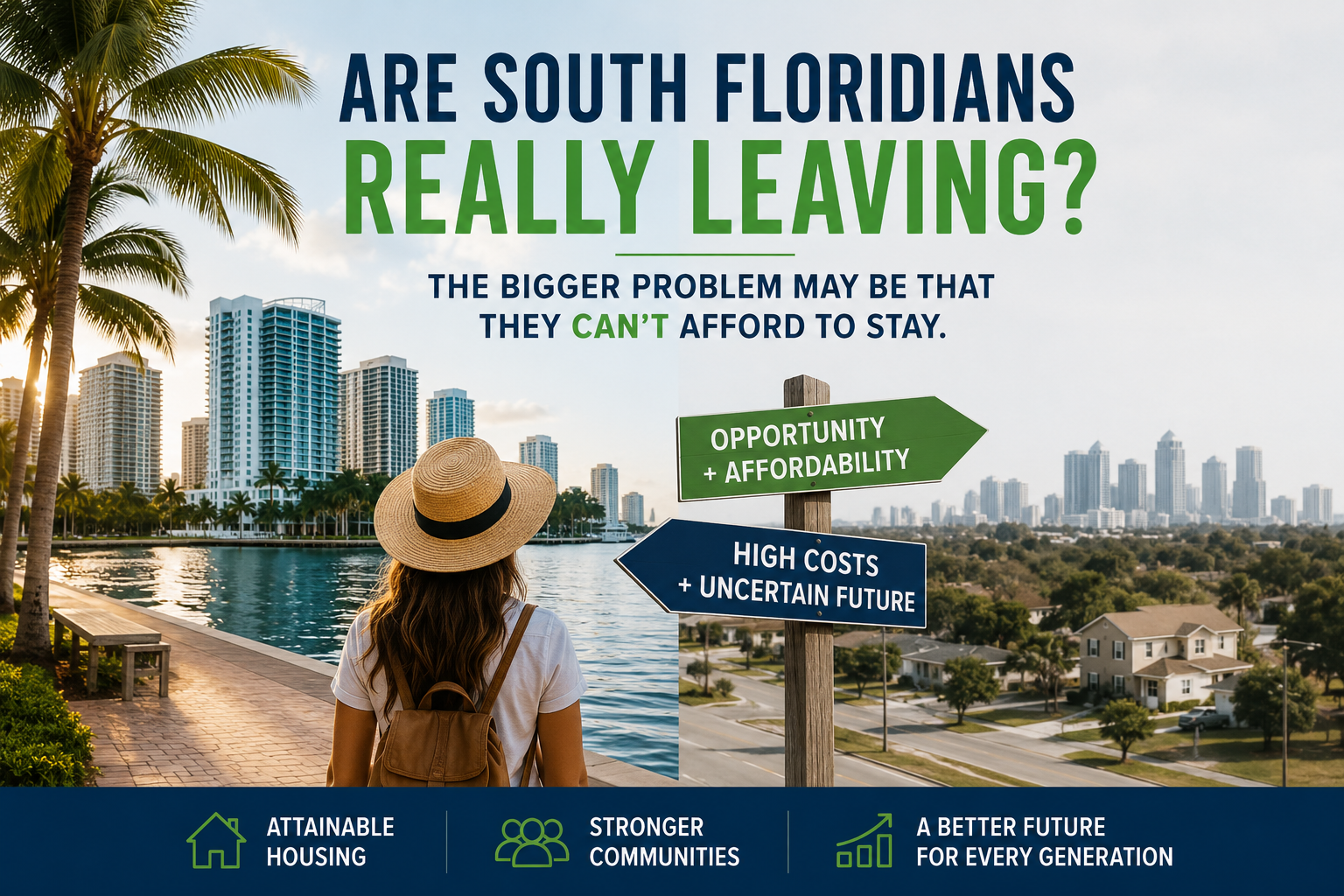
A recent report from the South Florida Business Journal highlights a trend that deserves more attention: younger South Floridians are increasingly looking beyond the region for their next chapter, while older generations are more likely to remain in Florida or relocate elsewhere in the Southeast.
At first glance, that might sound like another story about people fleeing South Florida. I don't think that's the whole story. In fact, I think the more important question is this:
"Are South Floridians leaving because they don't want to live here anymore—or because they can't build the life they want here?"
Those are two very different problems.
The South Florida Dream Has Changed
For decades, South Florida sold a pretty simple proposition: sunshine, beaches, economic opportunity, no state income tax and a lifestyle that people around the country wanted.
And people still want it.
Fort Lauderdale continues to attract newcomers, and U-Haul's 2025 data ranked Fort Lauderdale as the strongest growth city in the tri-county South Florida region.
The problem isn't necessarily demand. The problem is attainability.
For a young professional starting a career, a teacher, nurse, police officer, hospitality worker, small-business owner or young family, the calculation can be very different from that of someone arriving with substantial equity or a high six-figure income.
You can love where you live and still decide you can't afford to build your future there. That's not a failure of the individual. It's a warning sign for the community.
We're Losing Some of Our Future Residents
One of the most concerning parts of the current migration story isn't that retirees are moving around.
People have always relocated when they retire. The bigger concern is what happens when a 25-year-old who grew up here looks at the cost of rent, insurance, transportation and eventually homeownership and decides: "I can build a better life somewhere else."
NBC 6 recently highlighted exactly that sentiment among younger Miami residents, including Gen Z residents who said they wanted independence but couldn't make the numbers work locally. U-Haul's latest migration data shows just how different migration can look depending on generation and stage of life. Older generations continue to favor the Southeast, while younger movers are more likely to pursue major employment centers and cities offering different combinations of jobs, housing and lifestyle.
That's important. Because a city can continue growing while simultaneously becoming harder for its own children to stay. Those two things can happen at the same time.
This Isn't About Making South Florida "Cheap"
Let's be realistic. South Florida is never going to be the cheapest place in America to live.
And it shouldn't necessarily try to be.
We have waterfront property. We have international connectivity. We have tourism, finance, healthcare, technology, hospitality, entertainment and a rapidly evolving business community.
Those things have value. The answer isn't to make South Florida cheap. The answer is to make South Florida attainable. There is a difference. Attainability means giving people more opportunities to participate in the community at different price points and stages of life. That could mean more workforce housing. More thoughtfully designed multifamily housing. More opportunities for first-time buyers. More housing options between a luxury condominium and a single-family home. More accessory dwelling units where appropriate. More transit-oriented development. More housing near employment centers. And, perhaps most importantly, a willingness to have an honest conversation about what it actually costs to live here.
We Need to Stop Thinking About Housing as One Market
One of the mistakes we make in conversations about South Florida real estate is treating "the housing market" as though everyone experiences it the same way. They don't. A retiree selling a $1.2 million home in New York and purchasing a $900,000 condominium in Fort Lauderdale has a completely different housing equation than a 29-year-old who is trying to save $80,000 for a down payment while paying $3,000 a month in rent. A family with significant equity has different options than a young couple entering the market for the first time. A remote worker has different geographic flexibility than a nurse who needs to be within 20 minutes of a hospital. And someone who already owns a home has an entirely different set of choices than someone who is trying to buy their first one. One-size-fits-all housing policy doesn't work because one-size-fits-all housing doesn't exist.
So What Can We Actually Do?
There isn't one magic solution. But there are several things South Florida communities can do better.
1. Build More Housing People Can Actually Use
Not every new development needs to be ultra-luxury. We need a healthier range of housing options that allows someone to move through different stages of life without having to leave the region every time their circumstances change. The goal shouldn't simply be "more units." It should be more choices.
2. Make Homeownership More Accessible
For many younger residents, the biggest barrier isn't necessarily the monthly mortgage payment. It's getting into the house in the first place. Down payment assistance, first-time buyer programs, employer-assisted housing, education and creative financing options can help bridge that gap.
Real estate professionals also have an important responsibility here: educate buyers about what is actually possible rather than assuming the answer is simply, "You can't afford it." Sometimes the answer is a different neighborhood. Sometimes it's a condo instead of a single-family home. Sometimes it's buying farther inland. Sometimes it's waiting. And sometimes renting is genuinely the better financial decision. The point is to help people make an informed decision—not sell them a dream that doesn't fit their budget.
3. Think Regionally
If someone can't afford Fort Lauderdale, that doesn't necessarily mean they need to leave South Florida. Maybe Pompano Beach works. Maybe Oakland Park. Maybe Lauderdale Lakes. Maybe Dania Beach. Maybe a community farther west. The South Florida housing conversation needs to become less about individual cities competing with each other and more about creating a connected region where people can live, work and move through different stages of life.
4. Keep Young Talent Here
This may ultimately be the most important piece. Housing isn't just a real estate issue. It's an economic development issue. If nurses, teachers, first responders, young professionals and entrepreneurs can't afford to live anywhere near the communities where they work, eventually businesses have a harder time hiring. And when young people leave, communities don't just lose residents. They lose future homeowners. Future business owners. Future civic leaders. Future parents.
Future volunteers. Future elected officials. In other words, they lose the next generation of the community.
There's Another Side to This Story
We should also be careful not to interpret every moving truck as a vote against South Florida. People move for jobs. They move for family. They move for relationships. They move for school. They move because they want four seasons. They move because they're ready for a change. And sometimes they move away and eventually come back.
Migration is not a referendum. But it is information. And the information we're getting right now is worth listening to.
South Florida Still Has Something People Want
Despite all of this, I remain incredibly optimistic about South Florida. The same U-Haul data showing younger people leaving certain markets also shows continued movement toward the Southeast. And Fort Lauderdale itself has remained one of the region's stronger destinations. People still want to be here. They want the lifestyle. They want the weather. They want the beaches. They want the restaurants, culture and connectivity. They want the business opportunities. And many people who leave South Florida aren't leaving because they stopped loving it. They're leaving because the math stopped working. That's the part we can do something about.
The Future of South Florida Shouldn't Belong Only to the Wealthy
The real measure of a successful community isn't simply how many luxury towers we can build or how many high-income households we can attract. It's whether the person who grew up here can imagine staying. It's whether a recent college graduate can start a career here and eventually buy a home.
It's whether a young family can move from renting to owning without leaving the region. It's whether a teacher can afford to live in the community where they teach. It's whether a small-business owner can afford to open a business and raise a family here. And it's whether our children will have the same opportunity to call South Florida home that previous generations had. South Florida doesn't need to stop growing. It needs to grow more thoughtfully. Because the goal shouldn't be to prevent people from leaving. The goal should be to make leaving less necessary. And if we can do that, South Florida won't just remain a destination for people moving here. It can remain a place where the people already here can afford to stay.